
Northern Virginia Community College: Expanding Opportunities in the Skilled Trades
By Dr. Anne Kress, Northern Virginia Community College
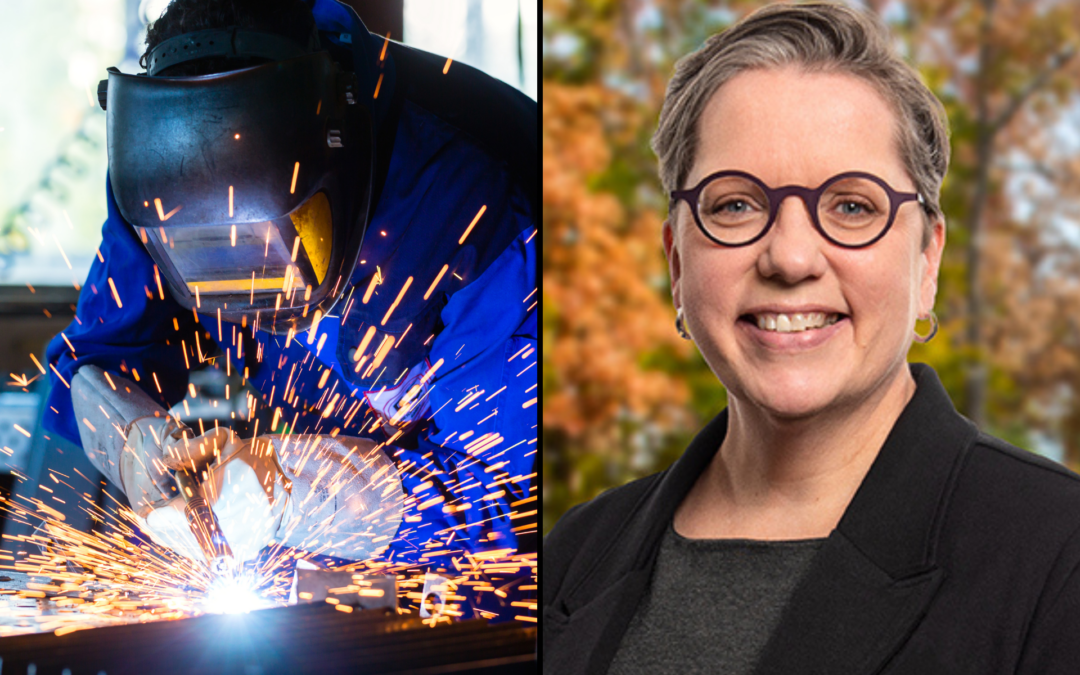
In 2025, Northern Virginia Community College (NOVA) will continue its focus on offering more opportunities for individuals in our region to develop the skills, knowledge, and credentials they need to enter jobs in Virginia’s high-growth industries. With new investments from public and private sources and guided by data that identify in-demand jobs, NOVA will expand workforce-focused programs in the skilled trades, offering new state-of-the-art labs and equipment. Our goal is two-fold: to enable more Virginians to accelerate their steps up the economic ladder and to meet the needs of the growing regional economy.
Virginia is currently among the 16 states in the nation experiencing the most severe labor shortages, according to the U.S. Chamber of Commerce. Overall, there are only 47 available workers for every 100 open job positions. Digging deeper into shortages in the skilled trades, research by McKinsey & Company, using U.S. Bureau of Labor data, found there were more than half a million openings for welders, cutters, solderers and braziers as of January 2024, an extraordinarily high number. Because welders are required to produce approximately 70% of all manufactured goods, such a significant shortage can limit production, jeopardize quality, and lower business productivity.
NOVA’s own Labor Market Intelligence and Business Engagement teams confirm strong local demand for workers in skilled trades such as welding and heating, ventilation and air conditioning (HVAC), and that employers are struggling to find those workers. Amazon’s announcement in 2023 that it will invest $35 billion in new data centers in the Commonwealth will intensify the demand for skilled trade workers such as electricians, HVAC technicians, plumbers, fiber optic technicians, and more to build, operate, and maintain the facilities that power the Internet services essential to modern life and business.
This data led NOVA to invest in our capacity to provide a workforce for the skills trades—and in 2025, this investment will begin to strengthen the talent pipeline.
This year, NOVA will renovate welding and HVAC labs on two campuses and add new lab space at a third. These improvements and expansions will double the capacity of our welding program. The HVAC program also will have increased capacity and a new focus on commercial HVAC. The economic results for students seeking these pathways are real and significant: according to Virginia Office of Education Economics (VOEE) data, the current median earnings per year for heating, air conditioning and refrigeration mechanics in the Northern Virginia area is $65,399 while median annual earnings for welders, cutters and solderers is $49,240.
At our Manassas Campus, NOVA will break ground on the Center for Building and Construction Trades, a state-of-the-art facility designed with input from industry that will allow us to enroll even more students in welding and HVAC programs and introduce new certificate programs in diesel engine mechanics, electric vehicle repair, generator installation and repair, electrical programming, and maintenance technician. To create even further and faster opportunities for students’ career growth and greater earnings, NOVA will to design these certificate programs to stack into associates degrees.
Expanding access to high-quality programs leading to high-demand jobs is an essential first step toward meeting the needs of the communities we serve, but our success depends on the outcomes of these programs. We are holding ourselves accountable to NOVA’s strategic plan and the Virginia Community College System’s strategic plan, both of which establish numeric goals to achieve by 2026. NOVA will increase by 20% the number of students enrolled in the highest-earning pathways, including workforce and transfer pathways. We will also increase by 20% the number of credentials and degrees awarded in the highest-earning pathways. These are jobs identified by the Virginia Office of Education Economics (VOEE) as high-demand occupations that require less than a bachelor’s degree and offer an annual wage high enough to provide economic stability, among other criteria. These improvements contribute to our system goals to increase the number of VCCS graduates who achieve greater economic mobility (40%) and stability (50%)—and even more importantly, they transform the lives of our students by connecting them to meaningful jobs and real economic opportunity.
Offering these pathways to well-paid jobs responds directly to the growing number of Americans seeking economic opportunity through means other than traditional higher education. At a time when more Americans are questioning the value of traditional higher education, NOVA is responding to residents of the Commonwealth and its businesses with new opportunities that lead to economic mobility and community prosperity. Or in the words of Caroline P., who earned a Career Studies Certificate in welding last May, “I definitely plan to make a career out of welding with what I learned at NOVA.”

The world and the workplace are changing. At the Presidents Forum, we believe that higher education must keep pace. That’s why we were formed in 2002, and why we continue our work to this day to reinvent higher education through innovation to benefit all student learners.
WHO WE ARE
NEWSROOM
80 M Street SE, # 130
Washington DC 20003
The world and the workplace are changing. At the Presidents Forum, we believe that higher education must keep pace. That’s why we were formed in 2002, and why we continue our work to this day to reinvent higher education through innovation to benefit all student learners.
80 M Street SE, # 130
Washington DC 20003





Recent Comments