


ROI Is the New Accountability
ROI Is the New Accountability
Why it matters
Higher education accountability has entered a new phase. Earnings, workforce alignment, and ROI are now central to federal policy.
The change
Through AHEAD rulemaking, the Department of Education implemented:
- Workforce Pell for short-term programs
- A new earnings-based accountability test
- Broader workforce alignment requirements
Congress set the tone: outcomes over inputs.
The new standard
Programs must show graduates earn more three years after completion than they would have without the credential.
Cost no longer factors into the federal test.
The employer opportunity
The traditional funding model is student pays, employer hires.
That model is breaking down.
In sectors like healthcare, employers face workforce shortages and high turnover costs. Redirecting dollars from bonuses and agency labor toward tuition assistance and loan repayment can improve ROI for both employers and students.
Bottom line
ROI is now the dominant lens in higher education policy.
Institutions that lead with workforce alignment and measurable outcomes will be best positioned in this new era.

The Power of Student Leadership
The Power of Student Leadership
Why it matters
Student voice is not symbolic. It shapes policy, funding, and institutional priorities in real time.
The story
Josiah Rodriguez, a first-generation college student at San Antonio College, enrolled the same day as his mother, who returned to earn her GED through Alamo Colleges’ adult education program.
Today, he serves as the first student trustee in the Texas system, representing more than 88,000 students across Alamo Colleges.
The impact
As student trustee, he:
- Serves as a liaison between students and the board
- Brings student concerns directly into trustee meetings
- Advocates for wraparound services that support persistence
- Helped support a fundraiser that raised $140,000 for GED programs
What makes this different
Alamo Colleges invests in systems that remove barriers:
- Free GED programs
- Food pantries and grab-and-go meals
- Childcare support
- Counseling services
- Community-based training centers
These services help students stay enrolled, protect Pell eligibility, and complete credentials.
Bottom line
Student-centered leadership is not theoretical. When institutions invite students into governance, the result is stronger policy, stronger support systems, and stronger outcomes.

The Overlooked Risk in RISE: Enrollment Intensity, Loan Limits, and Nontraditional Academic Calendars
By Amy Glynn, Policy Fellow
As the higher education community digests the Department of Education’s proposed rules following the RISE negotiated rulemaking process, much of the attention has appropriately focused on the elimination of Graduate PLUS loans, graduate loan caps, and the distinction between graduate and professional programs.
What has received far less attention is a quieter but disruptive change: the proposal to reduce annual student loan eligibility based on enrollment intensity, using a schedule defined by the Department.
For institutions operating on traditional semester calendars with largely full-time, residential students, this may appear manageable. For institutions that serve working adults, military-connected students, parents, and other nontraditional learners, particularly those using nonstandard terms, modular formats, or subscription-based models, this provision raises serious and unresolved concerns.
From “At Least Half-Time” to Proportional Borrowing
Historically, federal student loan eligibility has operated on a relatively simple threshold: if a student is enrolled at least half-time, they may access their full annual loan eligibility for that academic year.
The RISE proposal would fundamentally change that assumption. Under the new framework, annual loan eligibility would be reduced proportionally based on enrollment intensity. A student enrolled less than full-time would be eligible for only a portion of the annual loan limit proportional to the number of credits they attempt. On its face, this seems reasonable, aligning borrowing more closely with enrollment. But complexity emerges not in theory, but in practice.
Scheduled Enrollment vs. Actual Enrollment
Financial aid is awarded based on scheduled enrollment. New regulations, however, would have us look at actual enrollment.
Under the proposed rules, a student could:
- Be awarded loans based on full-time enrollment,
- Receive a disbursement at the start of a term,
- Remain enrolled and academically eligible,
- Complete fewer credits than anticipated due to work obligations, caregiving responsibilities, military service, or health issues.
If annual loan eligibility is recalculated based on actual enrollment, institutions may be required to retroactively reduce a student’s annual loan amount, after funds have already been disbursed and used for educational expenses.
This creates a new and unfamiliar compliance scenario:
- No withdrawal
- No failure to meet satisfactory academic progress
- No Return of Title IV (R2T4) calculation, yet the student loses access to loan funds in a future term.
Now, Let’s Look at a Real-World Example
Consider a working adult student enrolled in a modular, term-based undergraduate program.
The student registers for 12 credits in Term 1, meeting full-time enrollment requirements. Based on this scheduled enrollment, the institution awards the student their full annual Direct Loan eligibility, and the first loan disbursement is released at the start of the term. Tuition and fees for the full term are assessed and covered as expected.
Midway through the term, the student experiences an unanticipated life disruption, such as a change in work schedule or loss of childcare, and withdraws from Module 3. The student does not withdraw from the term or the institution, remains academically eligible, and completes 9 credits in Term 1. No R2T4 calculation is triggered, and the student remains in good academic standing.
In Term 2, the student enrolls full-time, with tuition and fees assessed accordingly. However, under the proposed enrollment-intensity-based loan limits, the student’s annual loan eligibility is recalculated based on the prior term’s actual enrollment. Because the student attempted fewer than 12 credits in Term 1, their annual loan limit is reduced.
As a result, the second loan disbursement is prorated, leaving the student with an unexpected balance owed in Term 2, despite full-time enrollment and continued academic progress.
From the student’s perspective, this outcome is both confusing and destabilizing. The student did not withdraw, did not fail academically, and did not change programs, yet a temporary and unavoidable life circumstance has resulted in reduced loan access for a future term.
For institutions serving working adults, military-affiliated learners, and student parents, particularly those using modular or nontraditional academic calendars, this scenario is not hypothetical. It reflects the lived reality of students whose enrollment intensity may fluctuate even as they persist toward completion. Without clear regulatory guardrails, a framework designed to align borrowing with enrollment risks, turning flexibility into a financial penalty.
Why Nontraditional Calendars Are Especially Exposed
This issue is amplified for institutions that operate outside the traditional semester model.
In modular or term-based programs:
- Enrollment intensity may vary intentionally across modules
- Students often accelerate, decelerate, or pause between modules
In subscription or competency-based models:
- Progress may not align neatly with credit-based enrollment status
- Enrollment is continuous, but intensity fluctuates
In these environments, enrollment variability is not an exception. It is the design.
Applying proportional annual loan reductions without clear safeguards risks penalizing students for the very flexibility that allows them to persist. This creates an administrative burden that is exponentially higher while ultimately obfuscating the funding journey and complicating student advisement.
The Equity Implications Are Real
Students most likely to be affected include:
- Working adults balancing full-time employment
- Student parents navigating caregiving responsibilities
- Military-affiliated students facing deployment, training, or relocation
- First-generation students managing unpredictable life demands
These students are often continuously enrolled, academically engaged, and progressing toward completion, but not always at a consistent credit load.
A policy that permanently reduces annual loan eligibility based on a single term of reduced enrollment could unintentionally undermine access and persistence for the very populations Title IV is meant to support.
Why This Moment Matters
This is not a question of whether enrollment intensity should matter but how it matters, and whether the rules recognize the realities of nontraditional students and nontraditional academic models.
If implemented without flexibility, this provision risks creating confusion for students, imposing administrative burdens on institutions, and unintended barriers to completion.
If implemented thoughtfully, it could align borrowing with enrollment without undermining access.
That balance is worth getting right. It requires colleges and universities, along with their financial aid professionals, to elevate this conversation so that students are not the victims of unintended consequences.
What’s Next in Federal Rulemaking
What’s Next in Federal Rulemaking
Why it matters:
Three major negotiated rulemakings are moving forward at the same time, each with significant implications for institutions and students.
The big picture:
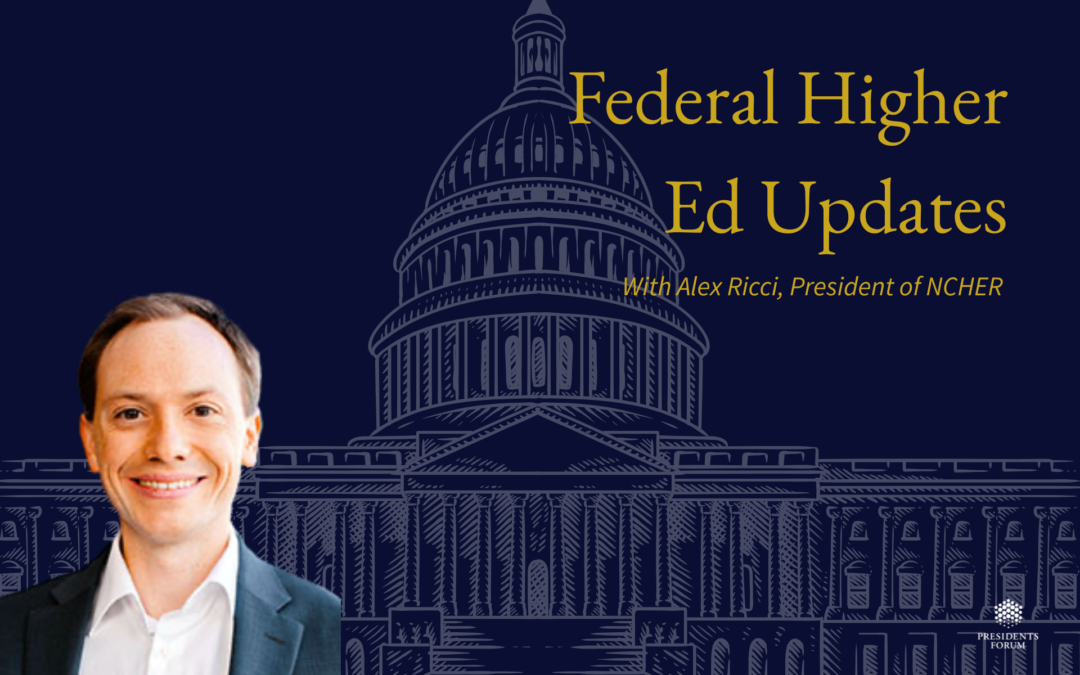
Alex Ricci of NCHER outlines where things stand with RISE, AHEAD, and the newly announced AIM committee. Each follows a different path, but all will shape federal student aid and accreditation policy.
RISE:
- NPRM published in late January
- Public comments due March 2
- Focuses on student loan provisions and implementation details
- Department is not strictly bound by prior consensus if public comments warrant change
AHEAD:
- Covers Workforce Pell and programmatic earnings accountability
- Committee reached consensus on both major issues
- Workforce Pell language is already at OMB for review
- NPRM expected in the coming weeks
AIM:
- Focused on Accreditation, Innovation, and Modernization
- Seeks to reduce regulatory burden and emphasize student outcomes
- Nominations due February 26
- Committee meets in April and May
Bottom line:
There is no slowdown in federal regulatory activity. Institutions that want to shape the outcome should track timelines closely and submit public comments where appropriate.
Recent Comments