
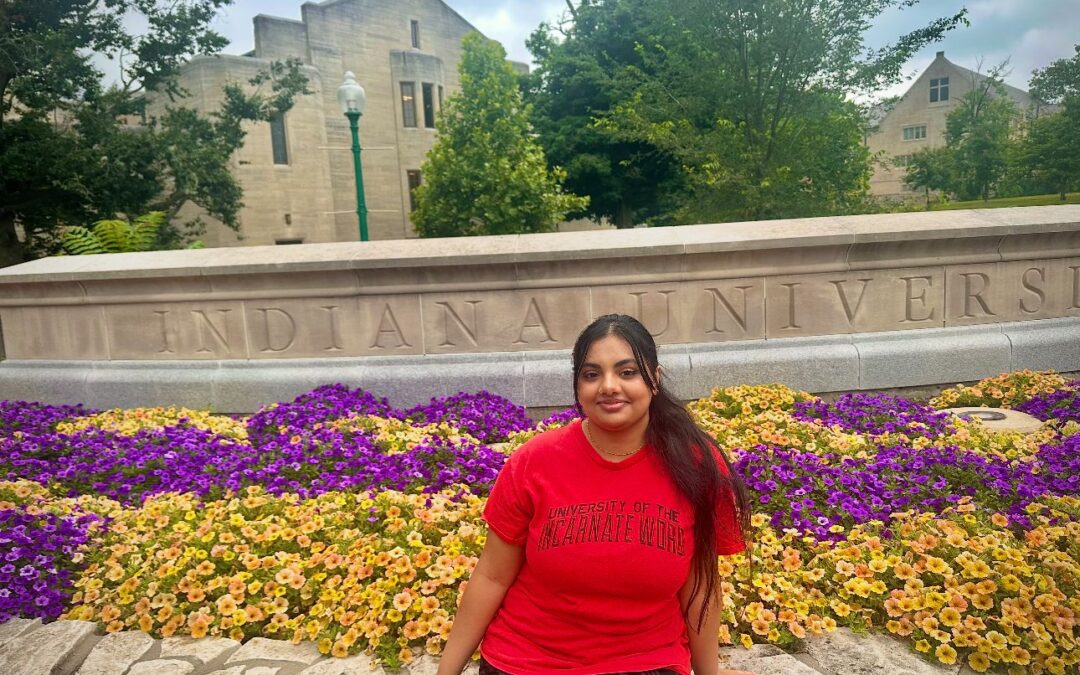
When Tania Kaur enrolled at St. Philip’s College in 2022 after graduating high school a year early, she was looking for an affordable way to begin her higher education journey. What she found was a supportive community of faculty and advisors who helped put her on a path to law school.
Now, Kaur is working toward her Juris Doctor at Indiana University Maurer School of Law and plans to graduate in May 2028. Her story shows that student success is not just about earning degrees, but also about transferring schools without losing time or money.
Kaur was the first in her family to go to college, and at first, figuring out degree requirements and the transfer process felt overwhelming. Her academic advisor, Christine Sauceda, and the Alamo Colleges District Transfer Advising Guides (TAGs) helped her plan her classes so her credits would count toward her bachelor’s degree at the University of the Incarnate Word (UIW).
After three semesters at St. Philip’s College, Kaur transferred to UIW with all her credits intact and nearly all her core requirements completed, allowing her to enter as a junior.
“None of that immense progress would have been possible without the great advisors at Alamo Colleges,” Kaur said.
She earned her bachelor’s degree from UIW, double-majoring in sociology and political science, with a focus on international relations and a minor in history.
Redefining Transfer Success
At Alamo Colleges District, student success means more than just transferring to a four-year school. What really matters is making sure the courses students take count toward their degree, so they can avoid extra classes, extra costs, and delays in graduating.
This idea is what drives the TAGs program.
Started in 2016, TAGs give students a clear academic path based on their major and the university they want to transfer to. The guides show which courses will transfer and how those credits will count toward a bachelor’s degree.
Over the past decade, the initiative has expanded from seven university partners to 22, with more than 3,000 Transfer Advising Guides developed to support student success.
Looking Beyond the Numbers
The growing number of transfer guides and university partners shows the program’s progress, but other measures also help tell the story of student success.
At the Alamo Colleges District, the average time to earn an associate degree is 3.4 years, compared to the statewide average of 3.6 years.
For students like Kaur, the impact goes beyond the numbers.
Her time at St. Philip’s College did more than just help her transfer. An introductory sociology class sparked a new interest that shaped her studies and future career goals.
Now in law school, Kaur hopes to pursue a career focused on human rights, family law, and child advocacy.
“You have the chance to gain the same level of education you would at a private institution for a much lower price. Plus, advisors and faculty at Alamo Colleges are truly there to support you and help you reach your goals,” Kaur said.
As the Alamo Colleges District continues to expand its university partnerships and improve the transfer process through new technology, its focus remains on helping students make the most of the time, effort and money they invest in their education.
For students like Kaur, that means turning an affordable start at a community college into a pathway to advanced education and a meaningful career.
Her story offers an important reminder for higher education leaders: measuring what matters means looking beyond transfer rates to ensure students’ credits count toward their degrees and move them closer to their goals.
Learn more about how the Alamo Colleges District is advancing student success through its Transfer Advising Guides.
Recent Comments