
Priyo Chatterjee, Chief Analytics Officer, Excelsior University
The Big Picture
During recent Hill meetings, one question came through consistently from policymakers on both sides of the aisle: How is AI actually improving student outcomes today? At Excelsior University, we have a direct answer — grounded in operational experience, measurable results, and a conviction that AI’s greatest value in higher education lies not in generating smarter reports, but in driving better decisions.
“Insight does not create impact. Decisions do.”
Why It Matters
Too often, AI conversations in higher education center on tools rather than impact. What policymakers and institutional leaders need is evidence that AI can improve persistence, enrollment, and operational effectiveness in tangible, measurable ways.
For years, analytics in higher education evolved from descriptive to predictive — answering what happened and what is likely to happen next. But a critical step has been missing: what should we do about it? The challenge is no longer access to data. It is translating insight into consistent, scalable action.
The Approach
Excelsior’s response was StIR — the Student Intervention Recommender — a suite of machine learning models designed to optimize the student journey across the enrollment and academic lifecycle. Rather than building isolated analytics tools, we embedded AI directly into the workflows where decisions are made.
StIR was built around three core questions:
- Which students are most likely to need support? (WHO)
- Why are they struggling or at risk? (WHY)
- What intervention is most likely to help? (WHAT)
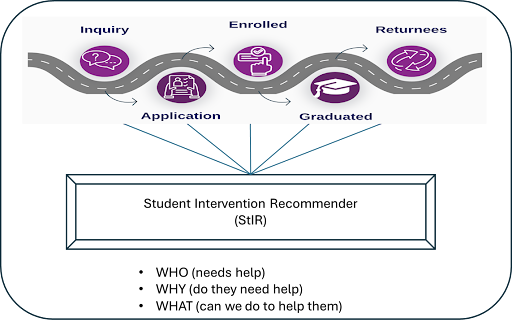
Figure 1. StIR platform illustrating the data-to-decision loop across the student lifecycle.
What Makes It Different: Human in the Loop
Today, the platform spans multiple modules — enrollment conversion, student melt, course success, and persistence. The most mature and impactful module targets “student melt”: students who register for courses but withdraw before beginning.
What distinguishes Excelsior’s approach is a deliberate “human in the loop” design. Rather than treating AI as an autonomous system, human judgment is built into every stage of the workflow. Our data science team works in close, ongoing collaboration with advisors to ensure model outputs are clear, interpretable, and directly actionable within advising workflows — not handed off and forgotten.
Equally important is the feedback loop. Advisors are not passive consumers of model recommendations. Their observations and frontline judgment are actively incorporated back into the system. This continuous dialogue between the people who build the models and the people who use them has made both the technology and the practice sharper over time.
By The Numbers
- 6 consecutive academic terms: lowest melt rates in institutional history across
- Approximately 309 full-melt students preserved over the six-term period
- $2.55M in annualized retained revenue impact
- Advisors shifted from reactive to proactive, prioritized outreach, improving how support capacity is deployed across the student population
What’s Next
Excelsior is also thinking about AI through a broader ecosystem lens. As higher education evolves toward more interconnected models — partnerships, stackable credentials, and multi-institution networks — AI becomes an enabling layer across complex learner pathways. We refer to this vision as a “constellation” model: institutions and learning experiences connected through shared intelligence and data-informed decision-making.
The most transformative opportunities in higher education AI lie not in generative tools for content creation, but in operational intelligence, intervention systems, and decision augmentation. Institutions that can identify friction points earlier and intervene faster will be better positioned to support students and manage enrollment pressure.
The Bottom Line
For policymakers asking how AI is improving student outcomes today — the answer is already here. Meaningful deployment is not a future aspiration. It is an operational reality, producing measurable results right now. Institutions must approach this work responsibly, with thoughtful governance, transparency, and human oversight. But the future belongs to institutions that make better decisions, consistently and at scale.
The real promise of AI in higher education: not intelligence for its own sake, but intelligence that drives action, impact, and outcomes.
Recent Comments